By MaryJane Obianuju Ayika | NurseMaryJaneSpeaks
Healthcare Professional | Health Technology Enthusiast | Founder, Every Life Counts Initiative
Artificial Intelligence (AI) has become one of the most transformative technological developments of our time. Yet, despite its growing influence across industries, I have observed that many people still have a rather limited understanding of what it can do.
For some, AI is simply a tool to which one asks questions and receives answers. For others, it is a technology to fear, dismiss, or associate exclusively with the possibility of job displacement.
But what if we looked beyond these perceptions?
What if, instead of asking only what AI can do for us, we began exploring what we could accomplish by combining it with our own intelligence, professional expertise, creativity, and problem solving abilities?
This is a perspective I have developed through my personal experiences of actively leveraging AI in my everyday activities, professional responsibilities, and entrepreneurial journey.
And I must say, AI has been one of the best things that has happened to me in recent times.
Not because it has replaced my ability to think, but because it has expanded the possibilities available to me when I put that ability to work.
The Problem Is Not Always the Technology; Sometimes, It Is Our Understanding of It.
One of the misconceptions surrounding AI is that its usefulness begins and ends with asking a question and receiving an answer.
While conversational question and answer interactions are among its most familiar applications, they represent only a fraction of its capabilities.
Depending on the tools available, AI can assist with drafting and editing documents, structuring proposals, developing educational materials, analysing data, generating images, creating videos, writing and debugging code, organising projects, developing business strategies, and translating complex ideas into accessible information.
It can also support the development of digital products, websites, educational platforms, and technology enabled services.
The possibilities extend far beyond what many people initially imagine.
However, discovering these capabilities requires more than opening an AI application and typing a random question. It requires curiosity, experimentation, patience, and an understanding of how to communicate one’s intentions effectively.
This is where prompting becomes particularly important.
Prompting: Translating Human Ideas into Actionable Instructions
A prompt is more than a question. It can be a set of instructions, a description of a problem, a project brief, a creative direction, or a detailed explanation of the outcome one hopes to achieve.
The more clearly we communicate our objectives, relevant context, constraints, and expectations, the better positioned an AI system may be to assist us.
Consider the difference between asking AI to create a document and explaining the type of document required, its intended audience, its purpose, its structure, its tone, and the specific information it must contain.
The second approach provides a clearer direction.
Even then, the first response may not be perfect. The process may require clarification, revision, additional instructions, and several rounds of refinement before the desired result emerges.
This is why patience matters.
AI is not a substitute for having a clear vision. It is a tool that can help us develop and execute that vision when we engage with it thoughtfully.
The ability to prompt effectively is valuable, but the ability to think critically about the response is equally important.
We must learn to assess what AI produces, identify errors, challenge assumptions, and refine the outcome until it meets the required standard.
My Personal Experience: From Everyday Tasks to Building Bigger Ideas
My appreciation of AI is not based solely on what I have read or heard about it. It is grounded in my own experience of using it.
There was a time when preparing certain documents meant visiting a business centre to have them typed or formatted. Today, I can begin that process from the comfort of my own space.
I can communicate what I want, specify how I want it presented, review the draft, request corrections, and refine the final document.
From professional letters to letterheaded papers and other materials, tasks that once required additional logistics can now be approached differently.
The technology has not eliminated the need for my input. I still have to understand what I need, provide the relevant information, make decisions, and check the final output.
But it has changed how I approach the work.
It has also changed how I think about what is possible.
When I began working towards registering Every Life Counts Initiative (ELCI), AI, working alongside my natural intelligence, became a valuable part of my journey.
From organising ideas to preparing documents and navigating different aspects of the process, I was able to explore possibilities that might otherwise have seemed more difficult to manage independently.
Of course, the actual legal and regulatory requirements still had to be met. AI could assist with preparation and problem solving, but it could not replace the relevant authorities or guarantee approval.
Nevertheless, the experience reinforced an important lesson for me: limited resources do not always have to mean limited ideas.
Sometimes, the difference lies in learning how to use the tools available to you.
From an Idea to a Health Education Initiative
My work on ELCI Learn Africa is another example of how I am exploring the intersection of natural intelligence and artificial intelligence.
As a nursing professional, I understand the importance of preventive healthcare, accessible health information, and empowering children and families with the knowledge they need to make informed health decisions.
However, translating a vision into a structured educational initiative involves several layers of work. These may include curriculum development, lesson structuring, age appropriate content, multilingual communication, educational resources, and digital delivery.
AI can assist with many of these processes.
It can help organise a curriculum, develop preliminary lesson drafts, simplify complex health concepts, generate educational ideas, and support the preparation of materials for different audiences.
The professional knowledge, contextual understanding, and critical judgement required to make those materials appropriate and reliable remain essential.
This distinction is particularly important in healthcare education, where inaccurate information can have consequences.
My vision for ELCI Learn Africa is not simply to produce more content. It is to explore how technology can help make health education more accessible, engaging, and scalable.
AI provides tools that can support that ambition, while the mission, values, and direction of the initiative remain human-led.
Exploring the Creative Possibilities of NurseMaryJaneSpeaks AI Studio
Another project through which I am exploring these possibilities is NurseMaryJaneSpeaks AI Studio.
I have been investigating how AI can support a video creation workflow, from developing an idea and writing a script to generating images, producing voiceovers, and assembling visual content.
Think about what this means for someone with ideas to communicate but limited access to a full production team or expensive equipment.
A person may have the knowledge, experience, and creativity to develop valuable educational content but lack the resources required to produce it in conventional ways.
AI-powered tools can help bridge some of those gaps.
They can make aspects of content creation more accessible, although the quality, cost, technical requirements, and amount of human editing vary considerably across tools and projects.
For me, the exciting part is not simply generating a video.
It is the opportunity to connect professional knowledge, storytelling, health education, and technology within a single creative process.
That is what happens when we stop viewing AI merely as a place to ask questions and begin exploring it as part of a broader problem solving process.
AI and the Future of Healthcare: Nurses Must Be Part of the Conversation
As a nursing professional, I am particularly interested in the implications of AI for healthcare.
I have observed conversations in which professionals joke about AI replacing people in other occupations, sometimes without considering how technological developments may also influence their own fields.
Nursing is not exempt from this conversation.
AI is already being explored and applied in areas such as clinical documentation, medical imaging, decision support systems, health data analysis, patient monitoring, and health education.
The extent of its impact will vary across settings, and not every application will be suitable for every clinical environment.
Nevertheless, healthcare professionals need to understand these developments rather than assume that their professions will remain untouched.
For nurses, this is an opportunity to participate in shaping how technology supports patient care, clinical workflows, health education, and service delivery.
Our clinical experience provides valuable insight into the problems that healthcare technology should address.
We understand the realities of patient care, the importance of communication, the challenges of healthcare delivery, and the consequences of decisions made in clinical environments.
These perspectives matter.
We should therefore be asking how AI can support our work, where its limitations lie, what safeguards are necessary, and how we can ensure that its use remains ethical, evidence-informed, and patient-centred.
The future should not be a conversation about healthcare professionals versus AI. It should be a conversation about how healthcare professionals can responsibly shape the use of AI.
AI cannot simply replace the empathy, accountability, contextual judgement, and human connection that are central to nursing.
Nor should the existence of AI encourage us to abandon critical thinking.
Instead, we must explore how it can complement human expertise while maintaining professional standards and patient safety.
Natural Intelligence + Artificial Intelligence: The Combination That Matters
Now, let me share the thought that inspired the title of this discussion.
While reflecting on my experiences with AI, I found myself thinking aloud about what might happen when we combine natural intelligence with artificial intelligence.
And I thought:
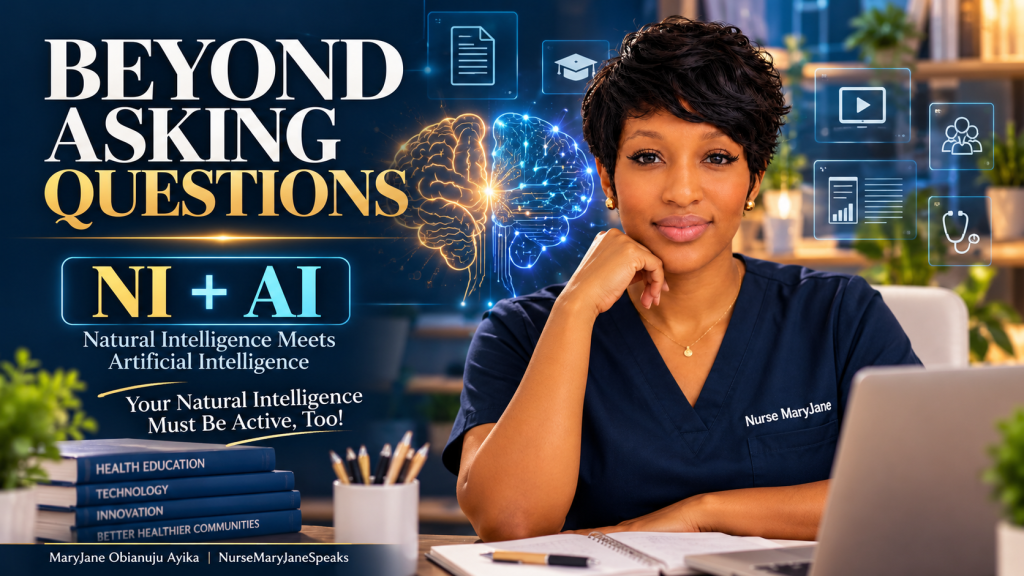
NI + AI = Natural Intelligence + Artificial Intelligence! 😎😂
It made me smile, but there is a serious point behind the humour.
Natural intelligence brings human understanding, creativity, experience, contextual awareness, critical thinking, and the ability to exercise judgement and responsibility.
Artificial intelligence offers capabilities that can help us process information, generate possibilities, organise complex tasks, and accelerate certain aspects of our work.
When these capabilities are brought together thoughtfully, they can open new avenues for productivity, innovation, and problem-solving.
But there is a condition.
Your NI must be active, too!
AI can generate a response, but can you determine whether that response makes sense?
AI can draft a proposal, but can you establish whether the proposal addresses the real problem?
AI can help develop educational content, but can you verify its accuracy and suitability for the intended audience?
AI can suggest a solution, but can you evaluate its limitations, implications, and potential risks?
These are not minor considerations. They are central to using AI responsibly and effectively.
The goal is not to switch off our brains and allow technology to do all the thinking.
The goal is to become more capable of applying our own intelligence with the assistance of technology.
And that requires learning, practice, discernment, and patience.
Is There Anything AI Cannot Do?
Sometimes, I am tempted to tell people: give me one thing AI cannot do, and I will show you what AI can do with it! 😎🤣😂
It is a bold challenge, and I say it with a sense of humour because I continue to discover new possibilities.
However, my underlying point is that many people have not yet explored the full range of tasks AI tools can support.
What appears impossible to one person may be achievable to another who understands the available tools, knows how to structure the problem, and is willing to experiment.
That does not mean AI can literally do everything.
It has real limitations. Some tasks require physical presence, human relationships, professional authority, access to specialised equipment, or capabilities that a particular system simply does not possess.
AI can also produce inaccurate information, fail to understand context, and generate outputs that require substantial correction.
Some applications involve financial costs, technical barriers, privacy concerns, or regulatory requirements.
Recognising these limitations does not diminish the technology’s potential. Rather, it helps us use it with greater understanding.
My challenge is therefore not a claim that AI is omnipotent.
It is an invitation to explore before dismissing it.
Before concluding that a task cannot be approached differently, investigate the tools available, learn how to communicate the problem, experiment with appropriate solutions, and assess the results.
You may discover possibilities you had not previously considered.
A Call to Professionals, Creatives, Entrepreneurs, and Innovators
We are living in a period of rapid technological change.
Regardless of our professions, backgrounds, or current levels of technical knowledge, we have an opportunity to learn about the tools influencing our world.
We do not all need to become AI engineers.
We do not all need to build applications.
And we certainly do not need to adopt every new technology simply because it exists.
But we should be willing to understand the technologies relevant to our work, evaluate their usefulness, and consider whether they can help us solve problems more effectively.
For healthcare professionals, this may mean exploring AI-assisted health education, documentation, research, and workflow improvement.
For educators, it may mean developing new approaches to teaching and learning.
For entrepreneurs, it may mean investigating more efficient ways to test ideas, communicate with customers, and develop products.
For individuals with limited resources, it may mean discovering tools that make certain tasks more accessible.
In every case, the starting point remains the same: identify a problem, clarify the desired outcome, learn about the available tools, and apply human judgement throughout the process.
The opportunities will differ, but the willingness to learn remains valuable.
Conclusion: I Am Still Learning, and I Am Just Getting Started
My journey with AI is ongoing.
I am still learning, experimenting, developing ideas, refining projects, and discovering new ways to apply the technology.
Through my work on Every Life Counts Initiative, ELCI Learn Africa, and NurseMaryJaneSpeaks AI Studio, I am exploring how professional knowledge, creativity, and technological tools can come together to support meaningful work.
I do not claim to know everything about AI. In fact, the more I explore, the more I appreciate how much there is still to learn.
But I know this: we should not allow fear, assumptions, or limited exposure to prevent us from exploring opportunities that could be useful to us.
AI is not a replacement for natural intelligence. Its greatest value often emerges when people bring their own knowledge, experience, creativity, and judgement to the process.
So, the next time someone asks what AI can do, perhaps we should look beyond the familiar question and answer experience.
Perhaps we should ask what problems need solving, what ideas deserve exploring, and what we might accomplish by combining our own intelligence with the tools available to us.
As for me, I will keep learning, building, and exploring.
And I will keep reminding myself of one simple principle:
AI may provide the tools, but your natural intelligence must help determine how you use them.
NI + AI. Keep your mind active, your curiosity alive, and your possibilities open.
The rest? Hmmm! The rest is history!
MaryJane Obianuju Ayika
Founder, Every Life Counts Initiative | NurseMaryJaneSpeaks
Exploring the intersection of nursing, health education, technology, and innovation.
#NurseMaryJaneSpeaks #ArtificialIntelligence #AIinHealthcare #HealthTech #NursingInnovation #DigitalHealth #ELCI #ELCILearnAfrica


Leave a Reply